
There are two fundamental differences between RABS (Restricted Access Barrier Systems) and Isolators:
- Decontamination: Isolators allow for repeatable decontamination using automated systems (such as VHP—vaporized hydrogen peroxide), which can be performed on a batch-by-batch basis. In contrast, RABS typically require manual, thorough disinfection. Alternatively, decontamination can be achieved by vaporizing or fogging the surrounding room; however, this generally cannot be done on a per-batch basis, and manual disinfection may occur concurrently with the decontamination of the room itself.
- Pressure Differential: Isolators operate at a defined pressure differential relative to the surrounding environment, whereas RABS utilize airflow overflow to achieve aerodynamic isolation without a strictly defined pressure differential.
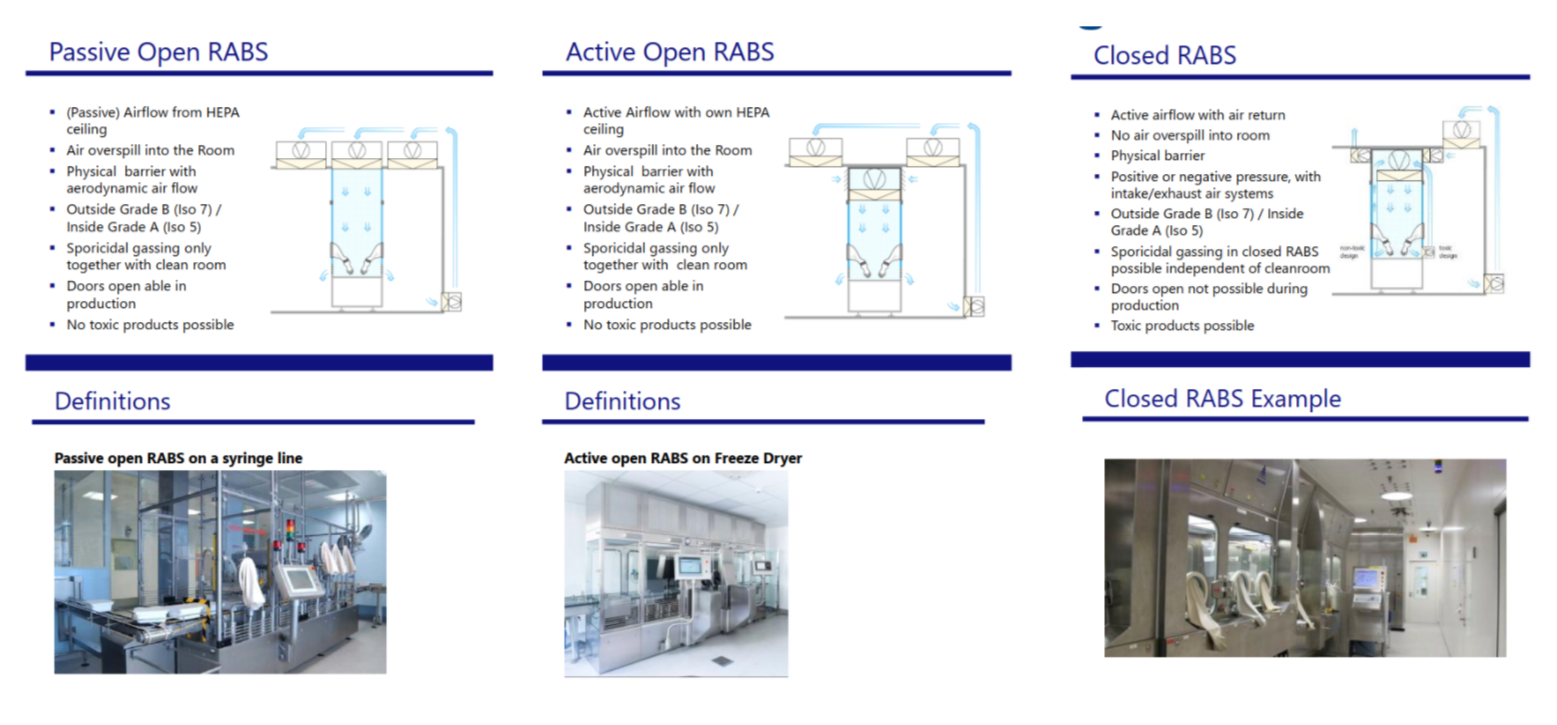
In terms of physical structure—specifically the air supply and return systems—c-RABS (closed RABS) are very similar to isolators. If c-RABS are used for the production of toxic products, leakage rates must also be controlled. Further distinctions between c-RABS and isolators can be made by examining features such as the inclusion of a decontamination system (e.g., VHP), integrated CIP (Clean-in-Place) capabilities, temperature and humidity control, and the methods used for material transfer. Essentially, c-RABS can be considered a simplified version of an isolator (offering a lower-cost alternative to full isolator systems).
| 1 | Project | RABS | Isolator |
| 2 | Level of Isolation | Superior to cleanroom environments | Superior to other barrier technologies |
| 3 | Background Environment / Internal Environment | Grade B/Grade A | Grade D (minimum) / Grade A |
| 4 | Barrier System Gloves | RABS gloves intended for use in Grade A zones must be sterilized prior to installation, and subsequently sterilized—or subjected to a validated decontamination method demonstrated to achieve an equivalent level of microbial inactivation—before each consecutive production batch or at validated, periodic intervals. | Routine cleaning (manual wiping) combined with vaporized hydrogen peroxide (VHP) decontamination |
| 5 | Pressure Differential | Closed-design systems (C-RABS) are capable of maintaining positive pressure. | Positive pressure; negative pressure may be considered for toxic sterile medicinal products (based on an assessment of the process and contamination risks) |
| 6 | Air Velocity | Guideline value: 0.45 m/s ± 20% | Guideline value: 0.45 m/s ± 20% (air velocity may be reduced, subject to evaluation and testing).
Closed isolators have no specific air velocity requirements. |
| 7 | Airflow | Unidirectional airflow | Open isolator design: Unidirectional airflow
Closed isolator design: Turbulent airflow |
| 8 | Temperature and Humidity | Depends on whether an air conditioning system is provided for the RABS air supply | Configurable Air Conditioning Systems |
| 9 | Leakage Rate | Leakage rate is generally not controlled; however, if a vaporized hydrogen peroxide (VHP) decontamination function is included, or if the system is used for the production of toxic pharmaceutical products, the leakage rate must be factored into the design | Leakage rate control to prevent the escape of disinfectants; isolators for toxic substances account for the risk of hazardous material leakage. |
| 10 | Cleaning / Washing | Manual wiping | Isolators used for the production of toxic or biologically active pharmaceutical products can be equipped with CIP/WIP (Clean-in-Place/Wash-in-Place) systems, while aseptic isolators used for non-toxic/non-biologically active products are designed for manual cleaning. |
| 11 | Disinfection and Sterilization | Manual wiping with disinfectants/sporicidal agents, or disinfection in conjunction with the background cleanroom | Equipped with automated decontamination functions, such as vaporized hydrogen peroxide (VHP) decontamination. |
| 12 | Material Transfer | The transfer method should be subject to a contamination risk assessment. Options include allowing for self-purification after opening a door, wiping the surfaces of items with a disinfectant, or utilizing specialized sterile transfer equipment, such as a Rapid Transfer Port (RTP).
|
Other methods involve the use of sterile transfer equipment, RTPs, or transfer chambers equipped with decontamination capabilities. |
| 13 | Door Opening | Interventions requiring the opening of the enclosure are kept to an absolute minimum—excluding those during the aseptic setup process—and are generally prohibited during routine production.
Any intervention involving the opening of the enclosure must undergo risk assessment and validation (covering aspects such as airflow, microbiological control, and Aseptic Process Simulation/APS) and must be documented. Typically, an auxiliary local laminar airflow system should be deployed around the area where the intervention takes place. Production equipment must be stopped and the immediate vicinity cleared before the enclosure is opened; following the intervention, the area must undergo local disinfection or decontamination. |
Opening the door is prohibited following disinfection/decontamination; however, for isolators used for handling toxic substances, the door may be opened once the hazard level has been sufficiently reduced. |
| 14 | Operational Mode | Process design must account for ergonomic constraints.
The system allows for relatively easy adjustments from initial operating modes. Compared to isolator systems, it is easier to retrofit into existing production lines. Transferring components, assemblies, and materials into an ISO Class 5 / Grade A zone presents a significant operational challenge, often requiring additional transfer airlocks and specific precautionary measures. Ergonomic limitations necessitate careful and appropriate process design. |
Moving Beyond Traditional Models
An automated decontamination airlock enables the repeated transfer of components, assemblies, and other materials into an isolator. |
| 15 | Facility Layout | 1. Requires a substantial facility layout, incorporating Grade C and Grade B zones, airlocks of various classifications, and additional localized Grade A air supply.
2. Material transfer requires an extended laminar airflow system. |
Compared to RABS (Restricted Access Barrier Systems), this approach allows for a more simplified and compact facility design, lowers the required background cleanroom classification, and reduces the need for buffer rooms and changing areas. |


