
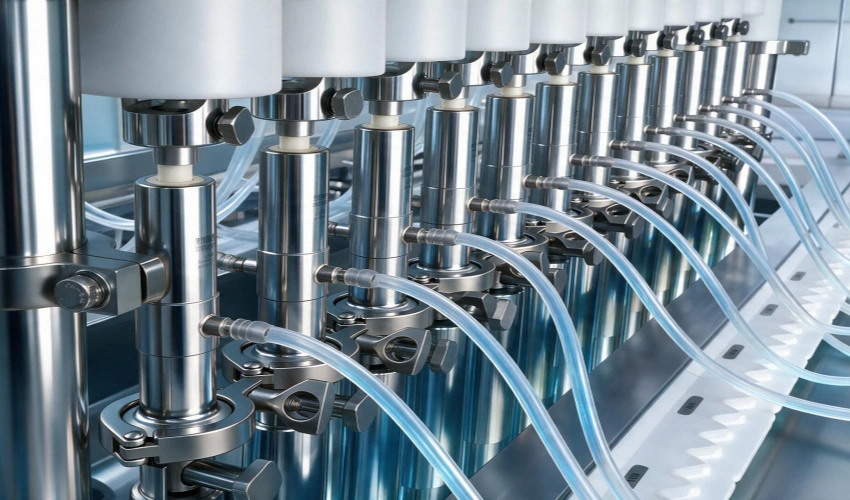
The dosing principle decides what the worst case is, which parts drift, and therefore which challenges an OQ must contain. A peristaltic filler and a piston filler can both hit the same target volume and still need quite different qualification protocols.
| Technology | Typical use | Worst case to challenge in OQ Wear or drift item to trend |
| Piston(volumetric) fillers | Syrups, suspensions and other moderate to high viscosity oral Liquids | Most viscous product, maximum speed, smallest fill on the largest cylinder Piston seals and valve wear, visible as a bias that grows overtime |
| Peristaltic pump fillers | Sterile injectables and smal-volume fils where low hold-up and quick changeover matter | Smallest fill volume, longest continuous run, product temperature after every tubing change Tubing lot and hours in use; re-verify fill weight after every tubing change |
| Gravity, time-pressure and overflow(level) fillers | Low-viscosity oral solutions, mouthwashes, topical liquids | Container dimensional variation, because a level fill delivers a constant height, not a constant volume Nozzle seals, and any change of container supplier or mould |
| Mass-flow or net-weigh fillers | Lines that dose by weight or flowmeter | Density and temperature change across the batch; flowmeter or load-cell calibration, as-found and as-left |
| Rotary and monoblock (fil-cap) machines | High-speed bottle and vial Lines, common in contract manufacturing | Maximum speed, every format change Star-wheel timing, closure torque |
| Aseptic systems(vials, ampoules, BFS, prefilled syringes) | Sterile products filled in Grade A RABS or isolators | Interventions, stoppages and restarts, aseptic process simulation performance Glove integrity, decontamination cycle |


