
DEPYROGENATING TUNNEL
HOW DEPYROGENATING TUNNEL WORK
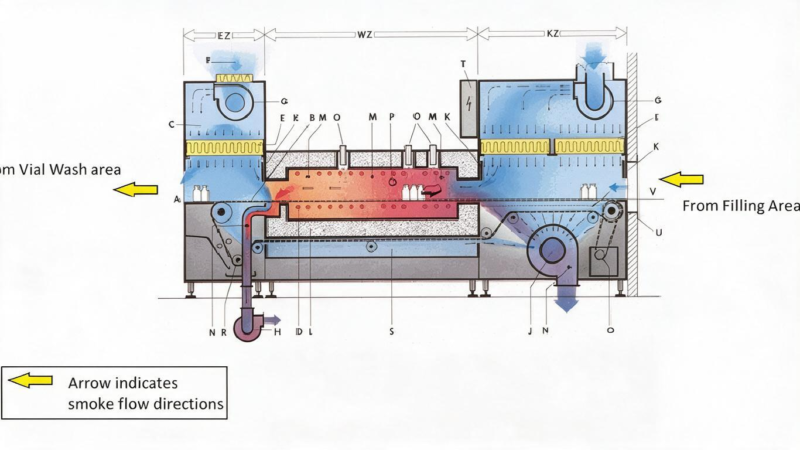
Dry, sterilize, cool and convey of vials & ampoules to take advantages of the hot air circulation being sanitized under the fixed high temperature heating and time to completely arrive at bacteria sterilization and degeneration.
The laminar flow dehydrogenating tunnels are the result of years of research and experience in the field of serialization and degeneration.The tunnels are suitable for being included in continuous production lines, which require a sterilization and degeneration process by dry heat for glass containers such as vials, ampoule, etc. The heating of containers is made by using hot air, treated with pre-flters and absolute filters HEPA or ULPA, which protect the container during the complete preheating sterilizing dehydrogenating and cooling process; along the entire length of the tunnel the air quality is lO5 as per lSO 14644. The machine designed and built according to cGMP standards, uses solution sat the forefront of technology and therefore is able to guarantee the repeatability and the absolute control of the process, and the easy use.
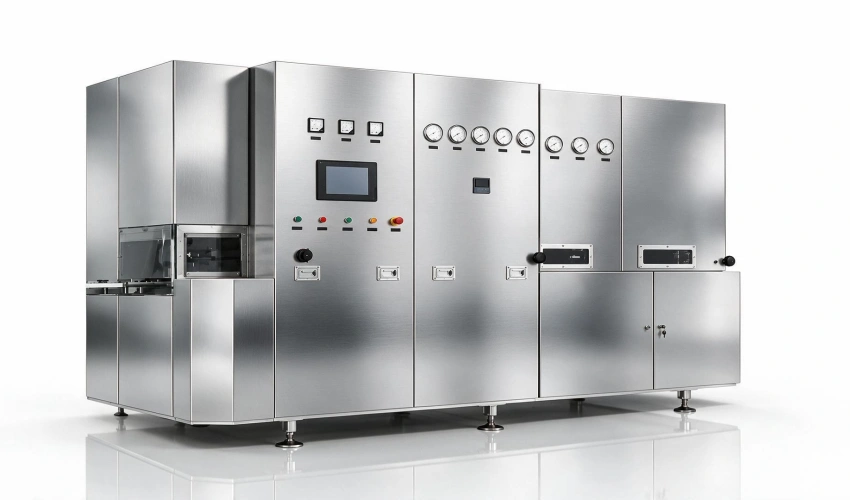
DEYROGENATION HEATING TUNNEL
Continuous Dry-Heat Sterilization and Depyrogenation Tunnel for Vial Sterilization and Depyrogenation: Suitable for high-volume vial production. Cleaned vials enter the tunnel and undergo preheating, dry heat treatment, and cooling before being conveyed to the filling station. Features include high-temperature treatment and proven heat treatment effectiveness, filtered air protection, contamination control in the cooling section, and stable upstream and downstream connections. It is designed for direct connection to bottle washing machines and aseptic filling machines.
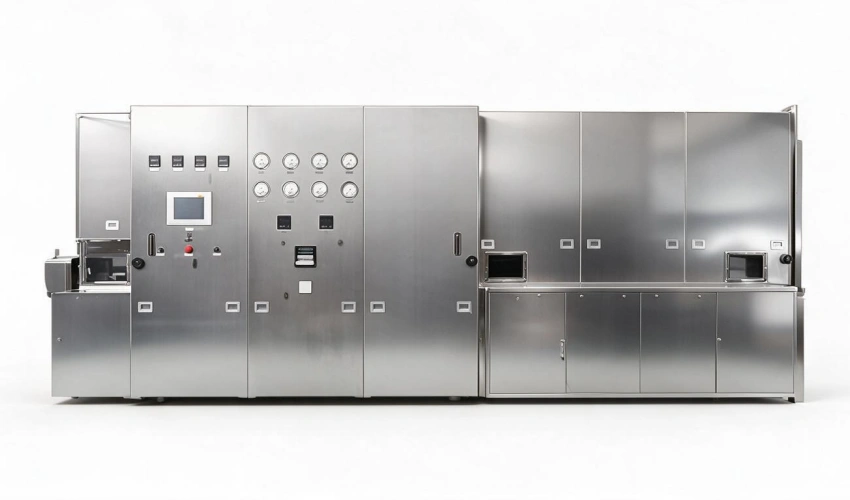
HEATING DYRING STERILIZATION TUNNEL
As materials move along a specialized conveyor belt through a high-frequency electromagnetic field that rapidly and continuously fluctuates, the polar orientation of the molecules within the materials shifts in response to the changing external electric field. This induces molecular motion and internal friction. The electromagnetic energy is converted into thermal energy, raising the temperature of the materials and enabling rapid, low-temperature drying. Regarding sterilization: Microwave sterilization eliminates microorganisms through the combined action of thermal and non-thermal effects. Application for 2ml – 15ml glass vials.
FAQ OF VIALS STERILIZATION TUNNEL
Any questions about the pharma glass vials sterilization and depyrogenation heating tunnel, please find the answer in the table.
What is a pharmaceutical depyrogenation heating tunnel?
Difference between sterilization and depyrogenation?
What endotoxin reduction should a depyrogenation tunnel achieve?
What operating temperature is required for a vial tunnel?
How is the residence time in the heating zone determined?
Does a depyrogenation tunnel should require HEPA filtration?
DEYPROGENATION HEATING TUNNEL BUYING GUIDE
Selecting the right pharmaceutical depyrogenation tunnel is an important decision for manufacturers of sterile injectable drugs, vaccines, and other parenteral products. The tunnel must provide reliable dry-heat treatment, consistent endotoxin reduction, controlled airflow, and protected transfer of sterilized glass containers to the aseptic filling area.
For pharmaceutical companies in the United States and Europe, purchasing decisions should consider more than heating temperature and production speed. Equipment design, thermal performance, HEPA filtration, line integration, data recording, and process validation are all essential.
SPECIFICATION OF STERILIZATION TUNNEL
| Модель | RHT-S50/2200 | RHTS-620/3400 | RHTS-620/4250 | RHTS-620/5000 |
|---|---|---|---|---|
| Заявка | 2-10ml | 2-10ml | 2-15ml | 2-20ml |
| Sterilization | 100-200 | 300-150 | 400-100 | 600-80 |
| Power w380v,50HZ | 25KW | 45kw | 74kw | 80kw |
| Working Temperature | 250℃-350℃ | 250℃-350℃ | 250℃-350℃ | 250℃-350℃ |
| Un-Loading | ≤±5% | ≤±5% | ≤±5% | ≤±5% |
| Width of conveyor | 400mm | 600mm | 600mm | 600mm |
| Out put temperature-Air | ≤40℃ | ≤40℃ | ≤40℃ | ≤40℃ |
| Out put temperature-Water | ≤25℃ | ≤25℃ | ≤25℃ | ≤25℃ |
| Additional Air Cooling-Air | 1500m3/h | 2000m3/h | 2000m3/h | 3000m3/h |
| Out put temperature-Water | 200m3/h | 400m3/h | 450m3/h | 500m3/h |
| Addition freezing water | 1-2 m3/h | 2-3m3/h | 3-4 m3/h | 3-5m3/h |
| Pressure and air balance control precision | ±2pa | ±2pa | ±2pa | ±2pa |
| Weight(kg) | 2000 | 3800 | 4800 | 5000 |
| Dimension(mm) | 2275x1645x1965 | 3400x1620x2200 | 4060x1620x2217 | 5000x1620x2070 |
| Noise | ≤60dB | ≤65dB | ≤65dB | ≤65dB |
GLASS VIALS DEPYROGENATION TUNNEL
CASE STUDY
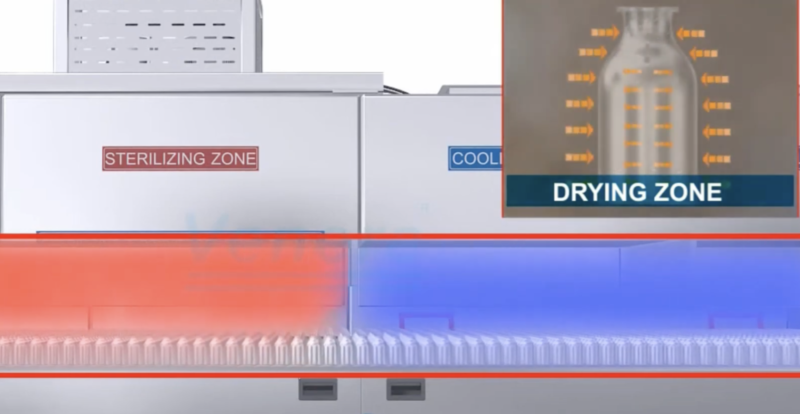
1. Pre-heating Warms containers and evaporates residual wash water before they enter the hot zone.
2. Hot zone delivers the depyrogenation effect. Reported operating range 220 to 350°C
3. Cooling Returns containers to a fillabletemperature underGrade A air.
Let's Work Together
Welcome to get in touch with us. You may fill out the inquiry form on the right side, or reach our team directly via the contact details listed below:
Feel free to send your inquiries, technical demands or quotation requests. Our professional sales & engineering team will respond within 8 working hours and provide tailored equipment solutions to match your production requirements.


