
Introduction
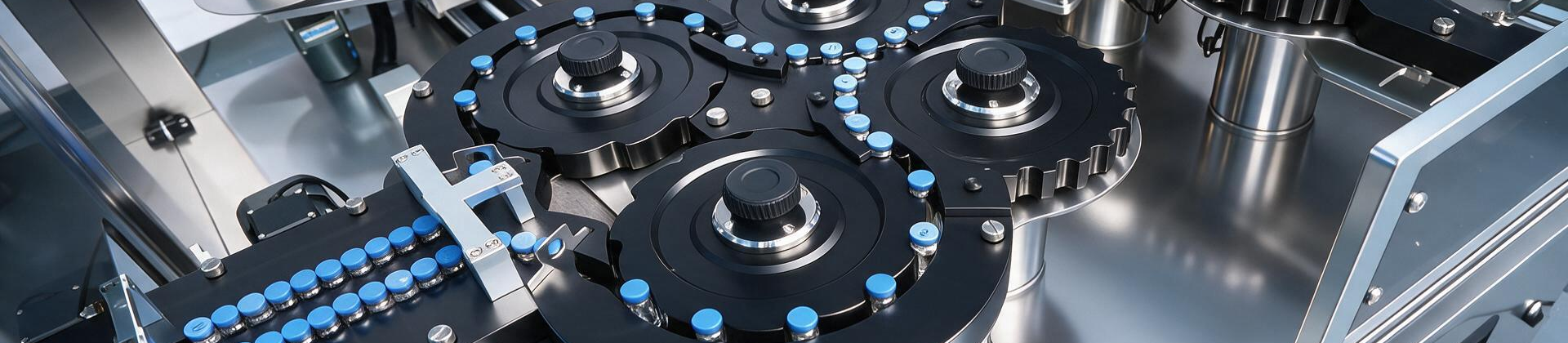
A labeling machine is specialized equipment used in the pharmaceutical industry to apply labels accurately and consistently onto containers such as bottles, vials, ampoules, cartons, and blister packs. These labels carry essential product information including drug name, batch number, manufacturing and expiry dates, dosage instructions and regulatory details.
Types of Labeling Machines:
- Manual Labeling Machines – Small-scale operations where operators apply labels by hand
- Semi-Automatic Labeling Machines – Operators manually feed the container while the machine dispensesand applies the label. Used for moderate batch sizes.
- Automatic Labeling Machines – Fully automated systems integrated with conveyors and sensors, capable ofhigh-speed labeling with minimal human intervention. Widely used in large-scale pharmaceutical packaging
- Specialized Labeling Systems- Machines designed for specific container types:
- Ampoule/Vial Labelers (wrap-around or partial)
- Bottle Labelers (front/back, wrap-around)
- Carton Labelers (top/bottom or side labeling)
- Blister/Card Labelers (for packs requiring patient-specific data)
Responsibility & Authority
| Role | Responsibilities |
| Labeling Operator /Technician | Execute the procedure as described, perform checks, cleaning, and documentation |
| Production Officer/Senior Operator | Supervise execution,review records, assist in troubleshooting |
| Quality Assurance(OA)/IPOA | Approve line clearance, review records, perform independent checks, audit compliance. |
| Maintenance /Engineering | Provide mechanical or electrical support, calibration of sensors or drives if needed. |
| Head Production/Packaging Manager | Overall accountability for labeling operations. |
Procedure
The procedure is divided into sub-sections:
Line Clearance & Pre-Start Checks:
- Line Clearance & Area Check- Obtain QA/POA clearance that ensures no leftover materials, andconfirm the area is clean (from previous debris and clean with 70% IPA) and organized.
- Machine Readiness – Verify only required labels/materials are present, and ensure all guards, covers,safety interlocks, and machine parts (rollers, guides, belts, sensors, etc.) are clean and functional.
- Pre-Run Verification – Run the machine empty to check movement and sensors, then perform andrecord sensor challenge tests (correctly sensing the container and labels gap).
Machine Start-Up & Labeling Operation
- Load the blank label roll.Thread the label web through the guide path and apply to the container as per machine design. Adjust
- tension, guide rollers, and scraper gap (~5-10 mm peel) as needed.Calibrate and set up the labeling machine (sensor, applicator, and HMI settings), verify sample labels
- C. for accuracyand clarity, and obtain QA/PQA approval before full-scale labeling.Continuously inspect containers for labeling quality, remove/reject faulty ones, and record alloperations, rejects, and corrective actions in the logbook.
Changeover/Label Roll Replacement:
- Stop the machine and let the conveyor and labeling mechanism come to rest。
- Remove the old label roll. Reconcile remaining unused labels, count, verify, log them, and segregatedestroy as per OA guidance (to prevent misuse ofold labels).
- Clean relevant rollers, peel surfaces, and guides (using 70% IPA or approved cleaning agent).
- Load the new label roll, thread the label path, adjust sensors, guides, tension, and apply a few testacontainers to confirm correct alignment and print. Repeat sensor challenge test.
- Request QA sign-off/ approval for the new label roll and changeover.e
- Resume operation following the steps in Section 2.
Cleaning & Shutdown
- Stop & Power Off- Finish labeling remaining containers, then shut down printer/coder and power offthe machine.
- Disassemble & Clean – Remove guards, belts, rollers, scrap bins, and leftover labels; clean all contact parts with 70% PA/lint-free cloths; clean surrounding area and conveyor.
- Reassemble &Inspect- Reassemble machine parts, ensure safe integrity.
- Documentation & Disposal- Record cleaning details in logbook and dispose ofwaste labels/adhesives as per SOP(deface/shred labels).
Post-Operations SOPs
- bel Reconciliation – Match printed, used, rejected, and unused labels; investigate discrepancies;a.destroy unused/damaged labels under QA supervision.
- Documentation & QA Oversight – Record all activities in logs, retain as per policy, and have QAbreview/sign-off. Report deviations or non-conformities as per SOP.
- SafetyMeasures – Check interlocks, guards, emergency stops; wear PPE; use approved solvents.
- Validation/Qualification – Ensure machine IQ/0Q/PQ; verify sensor performance, label placementaccuracy, and revalidate after changes in label/material/speed.
- Annexures/Forms -Maintain standardized forms (sensor test record, labeling log, reconciliation form,changeover checklist, cleaning log, deviation report).
Note:
- US FDA 21 CFR Part 211 (Subpart G: Packaging and Labeling Control) – particularly, use of labeling andpackaging materials ($211.122), strict control over labeling issuance and reconciliation ($211.125), and requirement for written procedures for packaging and labeling operations (§211.130).
- WHO GMP: Annex 2 (Good Manufacturing Practices for Pharmaceutical Products).
- EU GMP Guide, Part I, Chapter 5: Production


