
Sterile eye drops are among the most demanding pharmaceutical products to manufacture. Since ophthalmic solutions come into direct contact with the human eye, manufacturers must ensure the highest levels of sterility, filling accuracy, and production reliability.
Choosing the right sterile eye drop filling machine is critical for maintaining GMP compliance, improving production efficiency, and ensuring consistent product quality. This guide explains the key factors pharmaceutical companies should consider before investing in an ophthalmic filling line.
Why Is a Sterile Eye Drop Filling Machine Important?
Unlike ordinary liquid filling equipment, a sterile eye drop filling machine is specifically designed for aseptic pharmaceutical production. It minimizes contamination risks while accurately filling small-volume bottles, inserting droppers or plugs, and tightening caps automatically.
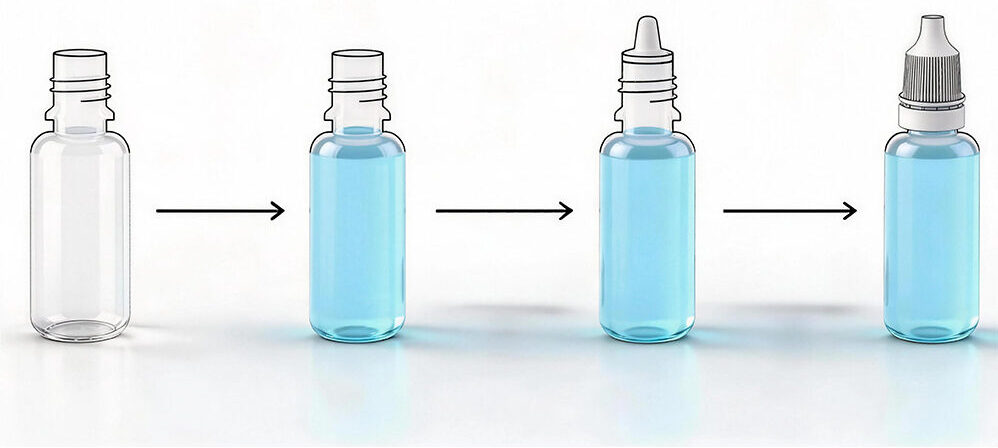
A modern eye drop filling machine typically performs:
Automatic bottle feeding → Precise liquid filling→ Dropper or plug insertion→Cap feeding and capping →Torque inspection →Rejection of defective bottles →Finished product discharge
These processes are completed within a controlled sterile environment to meet pharmaceutical regulatory requirements.
1. Ensure Compliance with GMP and FDA Requirements
The first consideration is whether the machine is designed according to international pharmaceutical standards.
Look for features such as:
- GMP-compliant hygienic design
- Stainless steel 316L product contact parts
- FDA-approved sealing materials
- Easy cleaning and maintenance
- Validation documentation (IQ/OQ support)
- 21 CFR Part 11 compliant software (optional)
- Audit Trail and Electronic Records capability
A GMP-compliant design not only simplifies validation but also helps manufacturers pass regulatory inspections.
2. Choose the Right Filling System
The filling system directly determines filling accuracy and product quality.
Peristaltic Pump Filling
Peristaltic pumps are widely used for sterile ophthalmic solutions because they offer:
Excellent sterility
No contact between pump and liquid
Quick tubing replacement
Easy product changeover
Suitable for multiple formulations
Ideal for: Eye drops, Artificial tears, Antibiotic solutions, Preservative-free products
Ceramic Piston Pump Filling
Ceramic piston pumps provide:
Extremely high filling precision
Stable long-term performance
High-speed production
Minimal maintenance
They are ideal for high-volume pharmaceutical manufacturing.
3. Verify Filling Accuracy
Eye drop bottles are typically filled with: 5 ml, 10 ml, 15 ml, 20 ml, 30 ml
Even slight deviations can affect product quality and regulatory compliance.
Choose equipment capable of achieving filling accuracy within ±0.5% (depending on filling volume and product characteristics).
Servo-driven filling systems generally provide better repeatability and accuracy.
4. Consider Bottle and Cap Compatibility
Different pharmaceutical companies use different packaging formats.
A flexible, sterile eye drop filling machine should support:
- LDPE eye drop bottles
- HDPE ophthalmic bottles
- Plastic squeeze bottles
- Round bottles
- Special-shaped bottles
It should also accommodate:
- Inner plugs
- Nozzle inserts
- Screw caps
- Tamper-evident caps
- Child-resistant caps (optional)
- Flexible tooling reduces changeover time when producing multiple products.
5. Evaluate Production Capacity
Production speed should match your manufacturing requirements.
Typical capacities include:
| Production Scale | Recommended Speed |
| Laboratory | 20–40 bottles/min |
| Small Batch | 40–80 bottles/min |
| Standard Speed Production | 80–150 bottles/min |
| High-Speed Production | 150–300 bottles/min |
High-speed lines usually integrate:
- Automatic unscrambler
- Filling and capping machine
- Labeling machine
- Cartoning machine
- Case packing system
6. Check Sterility Protection
Maintaining sterility is the most important requirement.
Modern aseptic filling machines should support:
- Laminar airflow protection
- ISO Class 5 (Grade A) filling area
- RABS (Restricted Access Barrier System)
- Isolator integration
- Hydrogen peroxide (VHP) sterilization compatibility
- CIP/SIP compatibility (where applicable)
- These features significantly reduce contamination risks during production.
7. Intelligent Inspection and Rejection Functions
A high-quality sterile eye drop filling machine should automatically detect production defects.
Common inspection functions include:
- No bottle, no filling
- No bottle, no stopper insertion
- No bottle, no capping
- Missing cap detection
- Crooked cap detection
- High cap detection
- Low liquid level detection
- Bottle jam detection
- Automatic rejection system
These automated inspections improve product quality while reducing labor costs.
8. Automation and Digital Control
Modern pharmaceutical production increasingly relies on intelligent automation.
Look for equipment equipped with:
- Siemens PLC
- Siemens HMI touch screen
- Servo motor control
- Recipe management
- Production data storage
- Audit Trail
- MES/SCADA connectivity
- Remote diagnostics
These features improve operational efficiency and simplify validation.
9. Easy Cleaning and Product Changeover
Pharmaceutical manufacturers often produce multiple products on one production line.
The filling machine should provide:
- Quick-change bottle guides
- Tool-free adjustments
- Easy pump replacement
- Fast cleaning procedures
- Minimal dead corners
This minimizes downtime and increases production flexibility.
10. Choose an Experienced Pharmaceutical Equipment Supplier
Selecting the right equipment supplier is just as important as selecting the machine itself.
A reliable manufacturer should provide:
| 1 | GMP-compliant machine design |
| 2 | Customized production solutions |
| 3 | Factory Acceptance Test (FAT) |
| 4 | Site Acceptance Test (SAT) |
| 5 | IQ/OQ documentation |
| 6 | Installation and commissioning |
| 7 | Operator training |
| 8 | Global after-sales support
|
| 9 | Spare parts availability |
Typical Applications
A sterile eye drop filling machine is widely used for manufacturing:
Antibiotic eye drops, Artificial tears, Lubricating eye drops, Anti-glaucoma medications, Steroid ophthalmic solutions, Mydriatic eye drops, Anti-inflammatory eye drops, Preservative-free eye drops, Veterinary ophthalmic solutions
Conclusion
Choosing the right sterile eye drop filling machine involves much more than comparing production speed. Pharmaceutical manufacturers should evaluate sterility assurance, filling accuracy, automation level, inspection capabilities, GMP compliance, and long-term service support.
A well-designed aseptic eye drop filling line not only improves production efficiency but also helps ensure consistent product quality, regulatory compliance, and patient safety.
If you are planning to build a new ophthalmic production line or upgrade an existing facility, investing in a reliable sterile eye drop filling machine will provide long-term operational and commercial benefits.


