
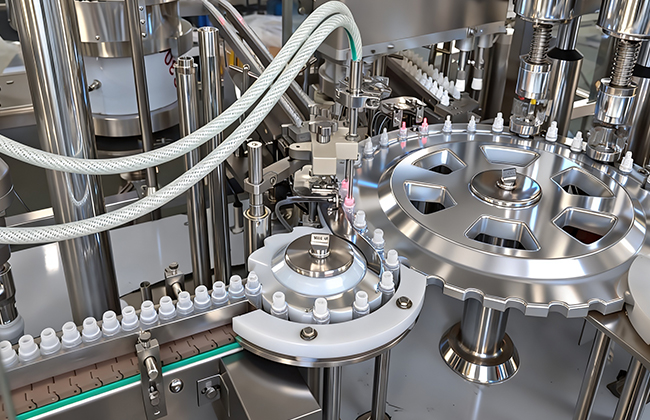
Filling machines can be classified according to different classification standards. Here are some common classification methods:
1. Classification by operation method:
- Manual filling machine: requires manual operation and is suitable for small-scale production or occasions with small filling volumes.
- Semi-automatic filling machine: Part of the operation is completed by the machine and requires manual assistance. It is suitable for small and medium-sized production.
- Fully automatic filling machine: The operation is completely completed automatically by the machine, suitable for large-scale production and high efficiency requirements.
2. Classification according to filling principle:
Overflow Filling Machines: These machines fill bottles to a level regardless of variations in the volume of the product, making them suitable for liquids with foam or those prone to splashing.
Piston Filling Machines: Piston fillers use a piston mechanism to measure and dispense precise amounts of liquid into bottles, making them ideal for thick or viscous liquids.
Gravity Filling Machines: Gravity fillers rely on gravity to fill bottles with liquid, making them suitable for free-flowing liquids without particulates.
Pressure Filling Machines: These machines use pressure to fill bottles, making them suitable for carbonated beverages or liquids that require a specific level of pressure during filling.
Volumetric Filling Machines: Volumetric fillers measure a fixed volume of liquid for each fill cycle, ensuring consistent fill levels across all bottles.
Time Gravity Filling Machines: These machines fill bottles based on a predetermined time interval, making them suitable for thin or non-viscous liquids.
Net Weight Filling Machines: These machines fill bottles based on weight, ensuring precise measurements, particularly for products sold by weight.
Auger Filling Machines: Auger fillers use a rotating screw mechanism to dispense powdered or granular products into bottles with accuracy and consistency.
Overflow Pressure Filling Machines: These machines combine the principles of overflow and pressure filling to fill bottles accurately while maintaining consistent fill levels.
Monoblock Filling Machines: Monoblock fillers integrate multiple filling functions into a single unit, including rinsing, filling, and capping, offering a compact and efficient solution for small to medium-scale production lines.
3. Classification according to filling materials:
- Liquid filling machine: used for filling various liquids, such as water, juice, oil, etc.
- Powder filling machine: used for filling powdery materials, such as flour, milk powder, etc.
- Granule filling machine: used for filling granular materials, such as raisins, nuts, etc
4. Classification by applicable industries:
- Food industry filling machine: suitable for the filling needs of food, beverage and other industries.
- Pharmaceutical industry filling machine: suitable for the filling needs of pharmaceutical, cosmetics and other industries.
- Chemical industry filling machine: suitable for the filling needs of chemical raw materials, liquid detergent and other industries.


