
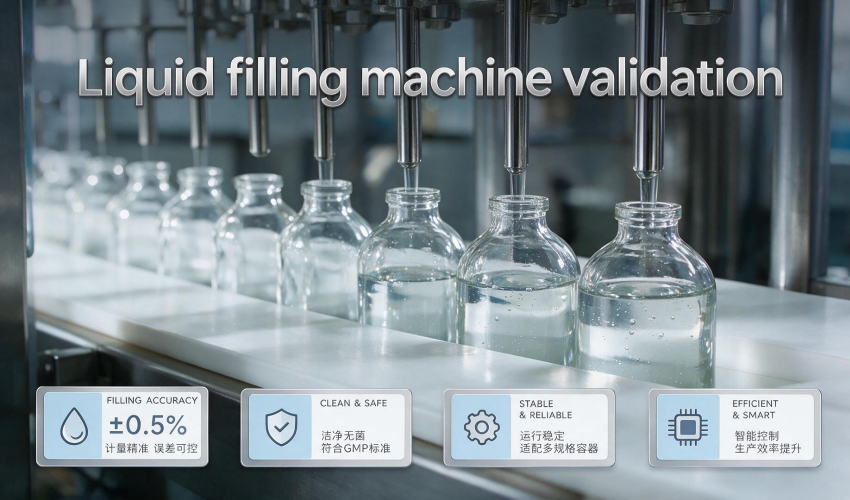
Liquid filling machine validation is the documented process of proving that a filling line, alone or as part of an integrated liquid manufacturing system, consistently fills containers within predefined specifications and protects the product’s quality attributes, including sterility and container closure integrity where they apply, throughout routine production. The objective is to show that the equipment, operated under defined conditions, repeatedly delivers conforming product over time.
Every major GMP framework asks for the same thing in different words. WHO’s guidelines on validation (TRS 1019, Annex 3) set out qualification and validation as a lifecycle, with a dedicated appendix on Qualification. In the US, 21 CFR 211.68(a) requires automatic and mechanical equipment to be “routinely calibrated, inspected, or checked according to a written program” , and FDA’s process validation guidance describes the three-stage lifecycle of process design, process qualification and continued process verification. For sterile lines, the revised Lampiran 1 GMP Uni Eropa, published in August 2022 and in operation from 25 August 2023, adds the contamination control strategy (CCS) as the frame around every filling decision.
Qualification:
Equipment qualification (DQ, IQ, OQ, PQ) is about the machine and its utilities: that the design meets GMP, that it is installed as designed, that it operates across its specified ranges, and that it performs with production materials or qualified substitutes under normal operating conditions.


