
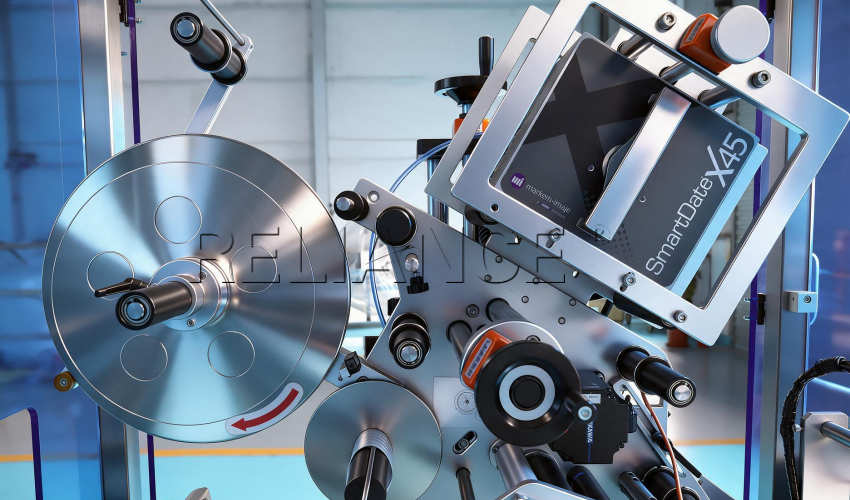
Comparison of Hot Stamp Coding, TTO Thermal Transfer Printing, and Laser Marking for Pharmaceutical Labeling Machines
Hot stamp coding, TTO thermal transfer printing, and laser marking are three common coding technologies used with pharmaceutical labeling machines. They can be used to print batch numbers, manufacturing dates, expiry dates, and other product information. However, they differ significantly in operating principles, consumable costs, print quality, and material compatibility.
For Shanghai Reliance Machinery’s pharmaceutical bottle labeling projects, particularly those involving amber glass anesthetic bottles, eye drop bottles, and oral solution bottles, the selection should consider label material, production speed, printing content, traceability requirements, and whether automatic online inspection is required.
1.1 Hot Stamp Coding
Working principle: Heated type characters + ink ribbon + label
Hot stamp coding uses heated metal characters to transfer ink from a ribbon onto the label through heat and pressure.
It is suitable for simple characters and fixed-format information. When the batch number or date changes, operators typically need to adjust or replace the type characters manually.
Ưu điểm:
Relatively low initial equipment cost.
Simple operating principle.
Suitable for basic coding applications.
Limitations:
Limited flexibility for variable information.
Changeovers may require manual intervention.
Not suitable for complex barcodes or QR codes.
1.2 TTO Thermal Transfer Overprinting
Working principle: Digitally controlled print head + thermal transfer ribbon
TTO uses a digitally controlled thermal printhead to transfer ink from a ribbon onto a label. The printing content can be updated automatically through the control system.
It supports variable information such as manufacturing dates, expiry dates, batch numbers, barcodes, and QR codes, making it suitable for production lines with frequent batch changes.
Ưu điểm:
Supports automatic printing of variable information.
High print quality for text, codes, and graphics.
Convenient recipe and content changes.
Suitable for automated pharmaceutical labeling lines.
Limitations:
Requires thermal transfer ribbons.
Printheads and ribbon transport components require maintenance.
Ribbon and label materials must be compatible.
1.3 Laser Marking
Working principle: Laser beam + material surface interaction
Laser marking uses a laser beam to create a mark through a controlled interaction with the material surface. It generally does not require ink ribbons or other marking consumables.
Depending on the laser type and material, it can produce text, batch codes, barcodes, QR codes, and other identification marks.
Laser marking can be applied directly to compatible bottle surfaces or to specially selected label materials.
Ưu điểm:
Typically eliminates ink ribbon consumption.
Supports digital changes to variable information.
Can produce durable marks when the material and laser process are suitable.
Suitable for automated coding applications.
Limitations:
Higher initial investment in many configurations.
Marking contrast depends on the material and laser parameters.
Glass marking requires process testing to avoid unacceptable surface damage.
Laser safety measures and, where necessary, fume extraction must be considered.
| Comparison Item | Hot Stamp Coding | TTO Thermal Transfer | Laser Marking |
| Initial equipment cost | Low | Medium to high | Generally high |
| Consumables | Ink ribbon and type characters | Thermal transfer ribbon | Usually no marking consumables |
| Automatic date and batch updates | Limited convenience | Supported | Supported |
| Barcode and QR code printing | Not suitable for complex codes | Supported, subject to print-quality verification | Supported, subject to marking-quality verification |
| Print quality | Suitable for simple characters | High-quality text and variable information | Depends on material and laser configuration |
| Batch changeover | May require changing type characters | Software-based content changes | Software-based content changes |
| Maintenance | Type characters, heating elements, and ribbon mechanism | Printhead, ribbon, and tension mechanism | Optical system, cleaning, and safety components |
| Material compatibility | Ribbon must match the label | Ribbon must match the label | Label or bottle surface must be suitable for laser marking |
| Typical applications | Simple dates and batch codes | Variable information on pharmaceutical labels | Durable marking on compatible materials |
Labeling Machine :


