
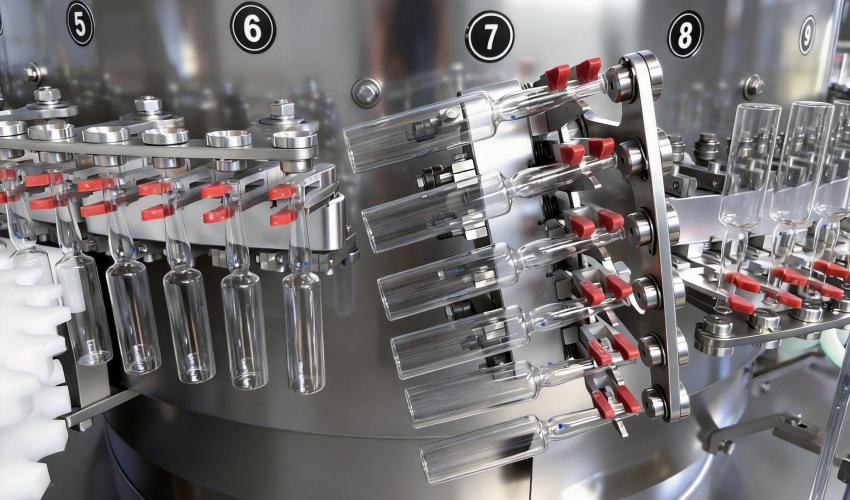
The qualification documentation can be adapted to the specific needs of the client offering an individual approach.
DESIGN PROTOCOLS
— Qualification Project Plan (QPP)
— Functional and Design Specifications (FDS)
— Hardware Design Specifications (HDS)
— Software Design Specifications (SDS)
— Risk Analysis (RA)
TEST PROTOCOLS
— Design Qualification (DQ)
— Computer System Validation (CSV)
— Factory Acceptance Test (FAT)
— Installation and Commissioning (IAC)
— Site Acceptance Test (SAT)
— Installation Qualification (IQ)
— Operational Qualification (OQ)
— Record of qualification deviations
— Record of qualification change controls
Documentation and Qualification of Pharma Filling and Packing Machines
The pharmaceutical industry is one of the most highly regulated industries in the world. Every pharma filling and packing machine must be supported by complete documentation and a structured qualification process to demonstrate compliance with GMP FDA 21 CFR Part 11 and EU GMP Annex 1 requirements. Proper documentation not only ensures regulatory compliance but also helps pharmaceutical manufacturers achieve consistent product quality, traceability, and successful audits.
This article explains the essential documentation package and qualification procedures for pharmaceutical liquid filling and packaging equipment.
Why Documentation and Qualification Are Important
Documentation and qualification verify that a machine:
- Performs as designed
- Meets User Requirement Specifications (URS)
- Produces consistent product quality
- Complies with GMP regulations
- Can be maintained and calibrated correctly
- Supports validation throughout its lifecycle
Without proper qualification documentation, pharmaceutical manufacturers may fail GMP inspections or delay production approval.
Documentation Package for Pharma Filling Machines
A professional pharmaceutical equipment supplier should provide a comprehensive documentation package.
- User Requirement Specification (URS)The URS defines the customer’s expectations, including:
| 1 | Product type |
| 2 | Bottle or vial specifications |
| 3 | Filling accuracy |
| 4 | Production capacity |
| 5 | Regulatory requirements |
| 6 | Cleaning requirements |
| 7 | Automation level |
| 8 | Data integrity requirements |
The URS serves as the foundation for equipment design and qualification.
2. Functional Design Specification (FDS)The FDS explains how the machine fulfills the URS.Typical contents include:
| 1 | Machine operating sequence |
| 2 | Software logic |
| 3 | Servo control strategy |
| 4 | Alarm management |
| 5 | Interlock logic |
| 6 | User interface design |
| 7 | Recipe management |
3. Hardware Design Specification (HDS)
The HDS describes all hardware components, including: PLC, HMI, Servo motors, Sensors, Pumps, Pneumatic components, Electrical panels, Wiring diagrams
4. Mechanical DrawingsTypical drawings include:
General Arrangement (GA), P&ID, Mechanical assembly drawings, Spare parts drawings, Format change parts, Utility connection drawings
5. Electrical Documentation, Electrical documents usually include: Electrical schematic, PLC I/O list, layout, Cable list, Electrical cabinet layout, Safety circuit diagram
6. Software Documentation, For automated filling systems:
| 1 | PLC program backup | √ |
| 2 | HMI project backup | √ |
| 3 | Software version records | √ |
| 4 | Password management | √ |
| 5 | Audit Trail configuration | √ |
| 6 | User access levels | √ |
7. Operating Manual, The operation manual should cover:
- Machine startup
- Product changeover
- Alarm troubleshooting
- Cleaning procedures
- Maintenance schedule
- Safety precautions
8. Maintenance Manual, Maintenance documentation includes:
- Lubrication schedule
- Wear parts replacement
- Preventive maintenance checklist
- Recommended spare parts
- Calibration procedures
9. Material Certificates, Critical product-contact components should include:
- Stainless steel certificates (typically SS316L)
- Surface finish certificates
- Elastomer certifications
- FDA-compliant material declarations
10. Calibration Certificates, Typical calibration documents include:
- Pressure gauges
- Temperature sensors
- Load cells
- Flow meters
- Weighing systems
- Torque testers
Qualification Process, Equipment qualification follows a lifecycle approach recommended by GMP and ISPE.
1. Design Qualification (DQ)
DQ verifies that the equipment design meets the URS and applicable GMP requirements before manufacturing begins., Typical DQ activities:
- Design review
- Risk assessment
- Component selection
- Hygienic design evaluation
- Compliance review
2. Factory Acceptance Test (FAT)
FAT is performed at the equipment manufacturer’s facility before shipment. Typical FAT tests include:
| Mechanical inspection | Alarm verification | Documentation review |
| Filling accuracy test | Recipe testing | Changeover demonstration |
| Speed verification | Safety interlock testing | Sensor testing |
3. Site Acceptance Test (SAT), SAT confirms that the equipment operates correctly after installation.Typical SAT includes:
- Utility verification
- Installation inspection
- Machine leveling
- Functional testing
- Product trial
- Operator training
4. Installation Qualification (IQ)
IQ documents that the equipment has been installed according to approved specifications. Typical IQ items include:
- Equipment identification
- Utility connections
- Component verification
- Instrument calibration
- Material verification
- Drawing verification
5. Operational Qualification (OQ)
OQ demonstrates that the equipment operates correctly throughout its intended operating range. Typical OQ tests:
- Filling accuracy
- Filling repeatability
- Speed testing
- Alarm verification
- Sensor challenge tests
- No bottle no fill
- No cap no capping
- Rejection system verification
- Emergency stop testing
6. Performance Qualification (PQ)
PQ verifies that the machine consistently produces acceptable products under actual production conditions. Typical PQ includes:
- Three consecutive successful production batches
- Statistical filling accuracy analysis
- Process capability evaluation
- Visual inspection results
- Reject rate analysis
Validation Documents Commonly Included , A complete validation package may include:
| No. | Document | Purpose |
| 1 | URS | User requirements |
| 2 | Risk Assessment | Identify potential risks |
| 3 | DQ Protocol & Report | Design verification |
| 4 | FAT Protocol & Report | Factory testing |
| 5 | SAT Protocol & Report | Site testing |
| 6 | IQ Protocol & Report | Installation verification |
| 7 | OQ Protocol & Report | Operational verification |
| 8 | PQ Protocol & Report | Production verification |
| 9 | Calibration Records | Instrument accuracy |
| 10 | SOP | Standard operating procedures |
| 11 | Preventive Maintenance Plan | Equipment maintenance |
| 12 | Spare Parts List | Long-term support |
Compliance Standards, Well-designed pharmaceutical filling and packaging machines are typically manufactured to comply with:
| 1 | * GMP (Good Manufacturing Practice) |
| 2 | * EU GMP Annex 1 |
| 3 | * FDA 21 CFR Parts 210 & 211 |
| 4 | * FDA 21 CFR Part 11 (for electronic records and audit trails) |
| 5 | * GAMP 5 guidance for computerized systems |
| 6 | * ISO 9001 Quality Management System |
| 7 | * CE Machinery Directive (where applicable) |
Choosing a Supplier That Supports Qualification, When selecting a pharmaceutical filling machine supplier, consider whether they can provide:
- Complete GMP documentation
- FAT and SAT support
- IQ/OQ protocol templates
- Validation assistance
- Audit Trail and electronic records
- Calibration certificates
- Long-term technical support
- Spare parts availability
- Remote troubleshooting services
An experienced supplier can significantly reduce qualification time and accelerate project commissioning.


