
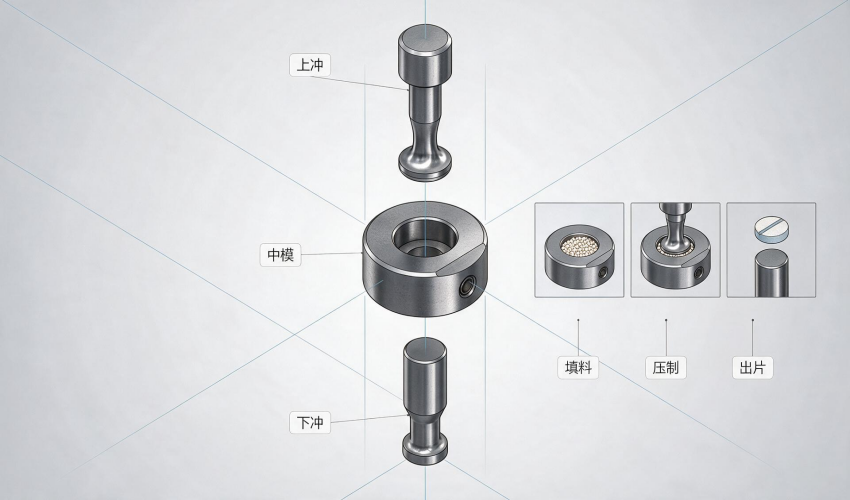
The vast majority of the tablets we take daily are not cast in molds; instead, they are formed by directly compacting powder using tens of tons of force. The machine that performs this task is called a rotary tablet press; a single unit—standing taller than a person—can produce hundreds of thousands of tablets per hour. This series of images breaks the machine down to show how the three steel components work together.
1) Overall appearance;
The tablet press is compact—standing just over the height of a person—yet it is the critical bottleneck for production output in a solid dosage workshop. At the top are the feed hopper and the forced feeder; the tablet compression chamber lies behind the protective glass doors in the middle section, and finished tablets drop from a side discharge chute into a collection bin. The entire machine is fully enclosed because the compression process generates dust; containment is necessary to prevent medicinal powder from escaping and polluting the environment, as well as to avoid cross-contamination between different powder batches.
2) Inside the chamber;
Opening the protective doors reveals the core component: a large rotating turret. Dozens of punch-and-die stations are evenly spaced around the turret’s edge, each consisting of an upper punch rod and a lower punch rod. As the turret rotates, the tips of the upper and lower punches slide along fixed guide rails; the rise and fall of these rails dictate exactly when the punches press down and when they lift. The two pairs of large wheels on the right are the pre-compression and main compression wheels; as the punches pass between them, they are subjected to intense pressure, forming the tablet.
3) The punch-and-die set;
Only three steel components are responsible for actually forming the tablet: the upper punch, the middle die, and the lower punch. The middle die is a thick ring with a precision-machined through-hole—the shape of this hole determines the shape of the tablet. The upper and lower punches act like pistons, inserting into this hole from above and below. Powder falls into the hole, and as the upper and lower punches squeeze together, the powder is compressed into a tablet. Whether a tablet is round or oval, or features a score line, depends entirely on the shape of the tooling set; changing the mold set changes the tablet type.
4) Four-step cycle;
With each full rotation of the turret, every set of punches and dies completes a four-step cycle. First, filling: the lower punch descends to a preset depth, and granules flow from the feeder into the die cavity. Next, leveling: a scraper blade removes excess powder; since this relies on volumetric measurement, the height of the lower punch directly determines the tablet’s weight. Then, compression: the upper punch descends, and both upper and lower punches are subjected to force between the pressure rollers, compacting the powder into a tablet. Finally, ejection: the upper punch retracts, the lower punch pushes the tablet up to the turret surface, and a guide plate sweeps it away. This entire four-step sequence takes less than a second.
5) Components and common issues;
The shape of the punch face is directly imprinted onto the tablet; the score line that allows for easy splitting is created by a raised ridge on the punch. Punches are consumable parts; with prolonged use, their edges may curl or chip, causing the resulting tablets to suffer from broken corners or cracked edges. The three most common defects in the tablet workshop are: capping (the top layer of the tablet separates), usually caused by rapid compression preventing air from escaping the powder; soft tablets (edges chip or crumble), caused by insufficient pressure or poor granule flowability; and sticking (powder patches adhere to the tablet surface), often caused by overly moist material or poorly polished punches.


